At the risk of having angry Shure SM7B devotees throwing glowing FetHeads at me, I thought it was time to shed some light on what I consider one of the great mysteries of the podcasting world: the widespread popularity of this microphone.
Maybe “shed some light” is already putting it a bit too grandly. This is neither a scientific analysis nor an attempt to educate anyone. I simply want to get this hot take off my chest: in my opinion, nobody (and I really do mean nobody) would choose a Shure SM7B as their podcast microphone based on blind listening tests alone. And you wouldn’t even have to compare it with expensive studio legends to prove the point. Just put it up against some significantly more affordable alternatives.
Because, if you ask its critics, the Shure SM7B is a bulky, heavy, slightly muddy-sounding and expensive microphone. And on top of that, it has a rather unusual XLR connector placement that can cause problems with certain mic stand configurations.
Another important point is its relatively low output level. The SM7B needs a fair amount of gain. Shure recommends around 60 dB of gain for typical voice recordings. If you don’t have a particularly high-quality audio interface or an exceptionally quiet microphone preamp, you’ll need to crank it up quite a bit. And potentially amplify not just the desired voice signal, but also the noise from your recording chain.
Suddenly, you’re not just the proud owner of a fairly expensive microphone. You’re also thinking about buying an additional preamp, such as a Cloudlifter, FetHead or one of its many cousins. A bit like buying a printer: the actual device is just the beginning of the expenses. :)
I Actually Like the Look. But That’s Not Everything.
I certainly won’t deny that the SM7B looks pretty damn cool. Quite the opposite: its design is genuinely brilliant.
A little side note: its iconic appearance was created by Gerry Plice, a microphone designer at Shure, who even received a design patent for it. So this thing didn’t become a design icon by accident.
And that is probably one of the reasons why it’s so popular beyond blind listening tests. It has enormous visual recognition. You see it in studios, on YouTube and in podcast setups everywhere. Eventually, it almost becomes part of the standard image of a professional podcast studio. A little herd mentality, a little status symbol and a generous dose of gear porn.
And honestly, I get it. A good-looking microphone isn’t just a tool; it can be fun to own, too. Unfortunately, though, that’s not an argument for it automatically being the best choice for your particular needs.
To give Shure some credit, its latest iteration of this studio classic does address the low output level. The SM7dB features a built-in active preamp, making external accessories like the Cloudlifter or the aforementioned FetHeads unnecessary.
Technically, that’s certainly an improvement. However, charging an extra €130 for fixing one of your own microphone’s biggest weaknesses is also a rather clever business move. Phew! Somehow, this isn’t getting any better. But: Well played, Shure. Well played.
One King and Seven Challengers
I really don’t want to spoil anyone’s enjoyment of their microphone. Nor do I think the SM7B is necessarily or fundamentally a bad microphone. I simply want to encourage anyone who’s still undecided to consider this: for the price of one SM7dB, you can buy no fewer than seven RØDE PodMics (and still get €4 in change, based on current Thomann prices).
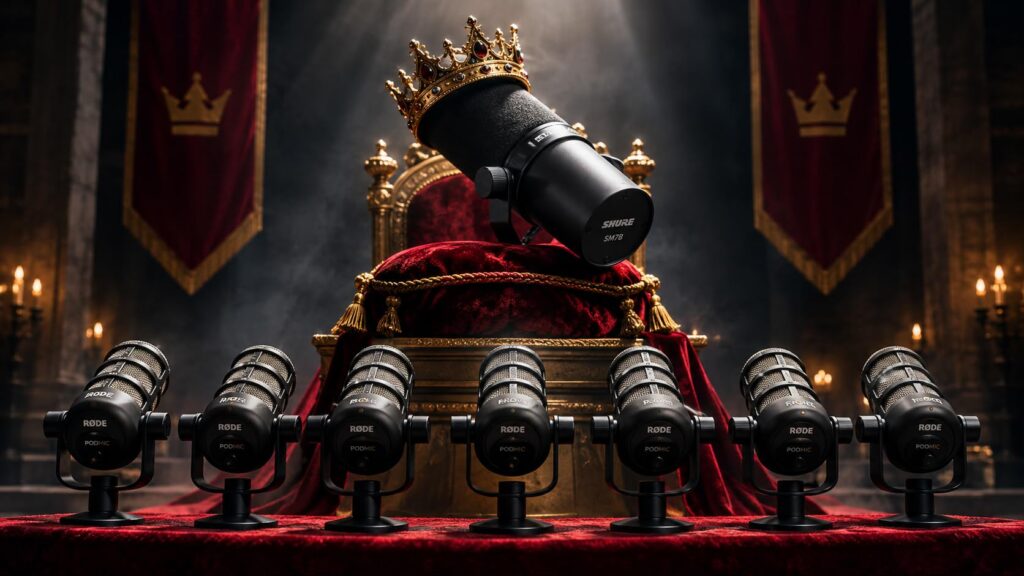
image generated with AI
Fun fact: I spent longer trying to come up with a pun involving the SM7B and the seven PodMics than I spent writing this entire article. And I still came up empty-handed.
I’ve been working in audio for more than 25 years now. And throughout that time, there have always been certain tools or pieces of equipment that became incredibly popular and achieved a kind of cult status. Sometimes more deservedly than others.
Maybe the SM7B is simply proof that good marketing, iconic design and the right celebrity endorsements can sometimes be worth more than a few extra decibels of output level.
And just so there’s no misunderstanding: I think that’s perfectly legitimate. A microphone is allowed to look good. It’s allowed to be fun to use and it’s allowed to be a bit of a status symbol. You just shouldn’t necessarily try to justify your purchase with technical arguments after the fact.
Happy Podcasting!